Gravity without
Grace: The Prologue to Lars von Trier’s Antichrist
“None of it is any use.”[i]
Prologue
As a cinematic
experience, Lars von Trier’s Antichrist
(2009) opens with a short prologue which is texturally different from the rest
of the film and is referenced in a brief flashback near the film’s end. Shot in
black-and-white and in slow-motion, the sequence of scenes which make up this Prologue
are themselves soundless, while an aria from Handel’s ‘Rinaldo’ is the foregrounded
musical accompaniment to the unfolding narrative. In this brief reflection I
will look closely at the Prologue, identifying some important image sequences
and their significance. Beyond this, I want to argue that the Prologue, more than just setting the
film off on its specific narrative arc, identifies a central philosophical
problem whose unrealized (and unrealizable) resolution is the crucial matrix of
the rest of the film’s characteristically violent narratives of attempted
existential integration. By using and developing some concepts drawn from the
work of Jacques Lacan I will argue that Antichrist
keeps alive the issue of the extent to which the Western psyche was, and
remains, Christianized: the film
confronts us with the West’s Christian unconscious, the obscene underside of
the anima naturaliter christiana: the
corpus naturaliter paganum. For von Trier, that confrontation
reveals the cost of the Western world’s religious solution to the mystery of
contingency.
1.
With the turning on
of a shower faucet by a male hand, the Prologue to Antichrist opens onto a world where the human and the non-human are
subject to the same pitiless mechanical forces. “He” (Willem Dafoe) and “She”
(Charlotte Gainsbourg) are having sex in the shower and for a few brief moments
it is easy to see this as a conventional film trope of an idealized romantic,
sexually fulfilling relationship. Very quickly, though, the film cuts to a
close-up, quasi-pornographic image of penetration, before cutting back to a
more visually coy image of the couple in the throes of intercourse.
The image of penetration framed by less explicit shots stands out as an unsettling instance of the kind of visual excess which has been considered widely in film studies on the basis of various versions of Lacan’s theory of the gaze, especially that of Slavoj Žižek in his analysis of pornography. The Lacanian gaze, as elaborated in Seminar XI, is, in Žižek’s formulation, “on the side of the object, it stands for the blind spot in the field of the visible from which the picture itself photographs the spectator”.[ii] So, what the spectator at first thinks of as a safe position from which to view the object is transformed into the uncanny position that is the constitutive condition of the human subject: a fissured subject that is both the site of looking and an object looked-at from a point he cannot see. As a consequence, the gaze stages the real of desire in the subject, the desire to be gazed at: just as the gaze emanates from outside of the subject, so does the object of desire; the gaze is actually the object a, the object-cause of desire in the field of the visual.
Žižek points out that the antimony between the eye and the gaze is abolished in pornography because in pornography there is no blind spot from which the gaze can emanate. Pornography is “the genre supposed to ‘show everything,’ to hide nothing, to register ‘all’ with an objective camera and offer it to our view.” Or as Todd McGowan puts it: “ pornography assumes that the objet petit a (in the form of the gaze) is an actual object that one can see rather than a distortion in the fabric of the social reality that one must see in the process of distortion itself. Thus, this direct rendering of the objet petit a fails because there is no actual object that one might pin down and display. In fact, the oft-noted tedium of the porn film stems from its obfuscation of the objet petit a in the effort to expose it. Pornography fails because the gaze, the objet petit a in the field of the visible, is irreducible to the field of the visible itself.”[iii]
By contrast, sex scenes in a non-pornographic film hold back from “showing it all” precisely in order to elicit the gaze, to depict as far as possible the real of desire which is not located in any object. “The films that actually enable us to recognize the gaze do so by making it visible as a distortion in this field.” [iv] For the pornographic film, by not cutting away and by showing everything, "[t]he sexual act...function[s] as an intrusion of the real undermining the consistency of th[e film’s diegetic] reality."[v] (Žižek 2000: 527)
In the Prologue to Antichrist the brief pornographic moment of “showing everything” is the first of a series of images where the viewer is confronted by the intrusion of the real in the midst of images where we also recognize the complex dynamics of the gaze. The viewer’s introduction to He and She are separate head shots where each looks out directly from the screen, implicating us almost immediately in the film’s diegetic reality in a way that is both voyeuristically compelling and deeply unsettling: we gaze at them, and though we can certainly read their gazes as being directed at each other, they are also gazing at us; we too are the objects of unknowable desires, perceptions and judgements in the same way that they are for us.
The pornographic intrusion at this point proves to be doubly unsettling. First, it undoes any claim the film might make to enact the logic of desire in any kind of satisfying way or with any kind of provisional closure—the boundary has already been overstepped, and any subsequent intimations of the gaze as object a will remain haunted by this. Additionally, though, by shaking the consistency of the film’s reality so early in the narrative, it hints at a self-critique of a major part of Cinema’s implied cultural functioning (including this film’s pre-release playing up of its Horror genre) as providing some degree of fantasmatic satisfaction.
I will return to and elaborate on this in a moment, but right now I want to continue by first examining a cluster of images whose conjunction, I think, is crucial to this film’s philosophical stance, and next, identify those places in the Prologue where von Trier’s cinematic renderings of the gaze operate to assert the gaze’s own philosophical implications, implications which are deeply congruent with that stance.
The image of penetration framed by less explicit shots stands out as an unsettling instance of the kind of visual excess which has been considered widely in film studies on the basis of various versions of Lacan’s theory of the gaze, especially that of Slavoj Žižek in his analysis of pornography. The Lacanian gaze, as elaborated in Seminar XI, is, in Žižek’s formulation, “on the side of the object, it stands for the blind spot in the field of the visible from which the picture itself photographs the spectator”.[ii] So, what the spectator at first thinks of as a safe position from which to view the object is transformed into the uncanny position that is the constitutive condition of the human subject: a fissured subject that is both the site of looking and an object looked-at from a point he cannot see. As a consequence, the gaze stages the real of desire in the subject, the desire to be gazed at: just as the gaze emanates from outside of the subject, so does the object of desire; the gaze is actually the object a, the object-cause of desire in the field of the visual.
Žižek points out that the antimony between the eye and the gaze is abolished in pornography because in pornography there is no blind spot from which the gaze can emanate. Pornography is “the genre supposed to ‘show everything,’ to hide nothing, to register ‘all’ with an objective camera and offer it to our view.” Or as Todd McGowan puts it: “ pornography assumes that the objet petit a (in the form of the gaze) is an actual object that one can see rather than a distortion in the fabric of the social reality that one must see in the process of distortion itself. Thus, this direct rendering of the objet petit a fails because there is no actual object that one might pin down and display. In fact, the oft-noted tedium of the porn film stems from its obfuscation of the objet petit a in the effort to expose it. Pornography fails because the gaze, the objet petit a in the field of the visible, is irreducible to the field of the visible itself.”[iii]
By contrast, sex scenes in a non-pornographic film hold back from “showing it all” precisely in order to elicit the gaze, to depict as far as possible the real of desire which is not located in any object. “The films that actually enable us to recognize the gaze do so by making it visible as a distortion in this field.” [iv] For the pornographic film, by not cutting away and by showing everything, "[t]he sexual act...function[s] as an intrusion of the real undermining the consistency of th[e film’s diegetic] reality."[v] (Žižek 2000: 527)
In the Prologue to Antichrist the brief pornographic moment of “showing everything” is the first of a series of images where the viewer is confronted by the intrusion of the real in the midst of images where we also recognize the complex dynamics of the gaze. The viewer’s introduction to He and She are separate head shots where each looks out directly from the screen, implicating us almost immediately in the film’s diegetic reality in a way that is both voyeuristically compelling and deeply unsettling: we gaze at them, and though we can certainly read their gazes as being directed at each other, they are also gazing at us; we too are the objects of unknowable desires, perceptions and judgements in the same way that they are for us.
The pornographic intrusion at this point proves to be doubly unsettling. First, it undoes any claim the film might make to enact the logic of desire in any kind of satisfying way or with any kind of provisional closure—the boundary has already been overstepped, and any subsequent intimations of the gaze as object a will remain haunted by this. Additionally, though, by shaking the consistency of the film’s reality so early in the narrative, it hints at a self-critique of a major part of Cinema’s implied cultural functioning (including this film’s pre-release playing up of its Horror genre) as providing some degree of fantasmatic satisfaction.
I will return to and elaborate on this in a moment, but right now I want to continue by first examining a cluster of images whose conjunction, I think, is crucial to this film’s philosophical stance, and next, identify those places in the Prologue where von Trier’s cinematic renderings of the gaze operate to assert the gaze’s own philosophical implications, implications which are deeply congruent with that stance.


Even in those initial moments when He and then She gaze out at us, they share the screen with the falling water-drops of the shower which are emphatically present in the image due to the lighting of the scenes and the slow-motion technique. Before He and She are shown as having sex, the film cuts to the bathroom’s ventilation fan sucking in the steam from the shower, and then cuts again to the livingroom window blown open by a gust of wind, beyond which we see the snow falling thickly. In all these cases the slow-motion allows the camera to linger on the physical movement, the mechanical falling of water and snow, the centrifugal spin of the fan, the opening of the window and the blowing about of the curtains. When the image of sexual penetration makes its brief appearance, it too takes on the character of a pneumatic back and forth. In fact, from now on in the Prologue virtually every scene in this elaborate montage will contain an image which emphasises motion and the physics of motion, the ineluctable operation of gravity: a tumbler with a toothbrush get knocked over in the shower by He and She; She’s foot kicks around the bathroom scale (a real measure of gravity with an actual cold numerical value); as they move from room to room in the throes of passion, He and She knock over their child’s (Nick) wooden picture-puzzle; in the laundry room their copulation is a counterpoint to the turning of the washing machine; our first view of the child’s bedroom shows us a cartoonish mobile of the moon and stars rotating over his cot, and ragdoll bear tied to a helium balloon floating in the foreground; pages on a table by the window are scattered by the wind; back in their own bedroom, She’s foot kicks over a bottle and spills its contents as she makes love with He. This is the way the physical universe operates—impersonal forces set objects in motion with inevitable physical results.


Spliced into this exemplary litany of Newtonian motion, however, are some scenes which begin to evoke the traumatic dimension of the accidental. Undoubtedly, kicking over and spilling a bottle of water might be an “accident”, but it is a qualitatively different kind of accident than some of the others presented: the child-gate “accidentally” left unlatched and the, perhaps, inadvertant muting of the electronic child-monitor. On the pure physical level these accidents of omission set the same kind of wheels in motion as the former, but their consequences happen to be radically different. In this case they lead up to Nick falling out the window to his death. They lead to the traumatic irruption of the real into reality.
Lacan, in Four Fundamental Concepts of Psychoanalysis, discusses accident/chance in terms of a distinction drawn from Aristotle between chance for subjects, tuché, and chance for objects, automaton. His point here is to give a thoroughly psychoanalytic account of the concept of causality and to distinguish cause from law (both scientific laws and moral laws). In cause, he says,
“there is always something anti-conceptual, something indefinite. The phases of the moon are the cause of tides - we know this from experience, we know that the word cause is correctly used here. Or again, miasmas are the cause of fever - that doesn’t mean anything either, there is a hole, and something that oscillates in the interval. In short, there is only cause in something that doesn’t work”.[vi] Fundamentally, automaton refers to the “automatic, lawlike, regulated stringing together of the subject’s signifiers in the unconscious”[vii], and so it concerns the process of repetition as well as the law of that process whose precondition is the evasion of cause: as though the signifying chain had been set in motion like a line of dominos falling. What automaton evades is the lack that sets the whole process going; it evades, in a word, the real.
By contrast Tuché, according to Malcolm Bowie, “is in one sense very simple: it is a tile falling on to the head of a passer-by, a person from Porlock bringing a creative trance prematurely to its end, or, to take one of Lacan’s own examples, a knock on the door that interrupts a dream" [viii]. These examples demonstrate the countless ways that the real can manifest itself in reality, the chance encounters, interruptions and accidents which foreground “something that doesn’t work”, traumas that function as the cause of a sequence, intimations of a structural lack in the symbolic order that we call reality. As Stephen Ross puts it:
“...the real, though never directly encountered (except perhaps in death), is everywhere felt in the radical contingency of daily life...[I]t forms the lie-giving truth that underwrites both of the remaining orders, the imaginary and the symbolic. In their basis upon and opposition to the real, then, these two latter orders have it built into their very fabric (if only by the vehemence of its exclusion), and we are compelled to read any disruption in either order as potentially an irruption of the real (even if it is masked in some way)”.[ix]
In the Prologue, the automatic operation of the laws of gravity turn into the Lacanian tuché when the little boy, Nick, entranced by the swirling snow, climbs up to the sill of the blown-open window, loses his balance and falls to his death. In the sheer physics of falling, the child’s body plunging to the ground is no different from the falling of his toy bear along with him. But for He and She it is a traumatic undoing of the structure of their world, an irruption of the radically unsymbolizable order of the real, the cause of all that follows in their lives. Von Trier neatly evokes the inability of the symbolic, the order of language, to encompass the encounter with the real by having Nic as he climbs on the table by the window swipe away the three emblematic ornamental figurines embossed with the names Grief, Pain, and Despair.

These are the only instances of language in the Prologue’s
diegetic reality, with the book behind them being metonymic for all written
culture. (They subsequently become the chapter titles for the next three parts
of the film, and are obliquely connected with a constellation named ‘The Three
Beggars’ later on. Their dismissal at the literal hand of Nick, who is the
locus of trauma and the irruption of the real, prefigures what I will later
contend is the film’s radical skepticism about the capacity of narrative and
metanarrative to provide existential succour.)
And so, the snow comes down, the washing machine comes to the end of its cycle, the great sex exhausts itself, the child falls to his death. There are laws of motion, there is the inescapable irruption of the real; there is a cause but there is no “why”, no answer. Just the truth of contingency.
And so, the snow comes down, the washing machine comes to the end of its cycle, the great sex exhausts itself, the child falls to his death. There are laws of motion, there is the inescapable irruption of the real; there is a cause but there is no “why”, no answer. Just the truth of contingency.
2.
Beyond what I am
essentially claiming above is the Prologue’s main theme, it is important to
return for a moment to the issue of how the gaze, in its specific cinematic
manifestations in this part of the film, structurally upholds that theme. In
fact, from a strictly philosophical viewpoint, I want to contend that the
Prologue as such enacts the epistemology of the Lacanian gaze rather than just
exemplifying it.
In the Prologue’s montage there is a remarkable number of different camera angles and shot positions. As viewers, these implicate us in different ways in the narrative, of course, as they structurally position us in relation to seeing and being seen; and the rapidity in shifts of position (underlined by the slow-motion) create a kind of anxiety as the camera cuts from mid-shots to close-ups, and eye-level views to high angle views to bird’s eye views in quick succession.
I have already mentioned the ways in which the gazes of He and She, and the early pornographic cut-in function to unsettle us as viewers and problematize our narrative pleasure. One other gaze adds significantly to this unease: there is Nick’s turning away from the primal scene of his parents having sex to look at and move to the open window where the snow is falling, but, as he turns, intersecting the viewer with his gaze and smile. As viewers we have already intimated the danger of the open window and the child’s turn towards us casts us into a position of helplessness in the face of an unfolding disaster. We will watch his death take place in the filmic reality, but his gaze, engaging us, alerts us to the constant presence of the real in our reality, behind the back of the symbolic, as it were.
But quite brilliantly von Trier chooses almost this precise moment in the film to use as a flashback late in Chapter 3, ‘Despair’. In the Prologue as Nick turns away from his parents the camera focus shifts from them to him; in the flashback, black-and-white and in slow-motion like the Prologue, the camera, in silence, cuts to a close-up of She’s face as she actually sees her son climbing on the table by the window just before he falls; her gaze of supressed horror meets our’s directly and contrasts radically with the Prologue’s last shot of her face, one of post-orgasmic satisfaction. (The two scenes together function like a portrayal of Freudian Nachträglichkeit where the only way She can try to integrate the trauma of the past event of death into the symbolic is to construct it, or “remember” it, as her failure, to see herself as blameworthy for being engaged in sex rather than confront the real in the tuché. And thus, in a terrible parody of the sex scene in the Prologue She masturbates using her unconscious, castrated husband’s hand, and then punishes herself by cutting off her own clitoris.)
In the Prologue’s montage there is a remarkable number of different camera angles and shot positions. As viewers, these implicate us in different ways in the narrative, of course, as they structurally position us in relation to seeing and being seen; and the rapidity in shifts of position (underlined by the slow-motion) create a kind of anxiety as the camera cuts from mid-shots to close-ups, and eye-level views to high angle views to bird’s eye views in quick succession.
I have already mentioned the ways in which the gazes of He and She, and the early pornographic cut-in function to unsettle us as viewers and problematize our narrative pleasure. One other gaze adds significantly to this unease: there is Nick’s turning away from the primal scene of his parents having sex to look at and move to the open window where the snow is falling, but, as he turns, intersecting the viewer with his gaze and smile. As viewers we have already intimated the danger of the open window and the child’s turn towards us casts us into a position of helplessness in the face of an unfolding disaster. We will watch his death take place in the filmic reality, but his gaze, engaging us, alerts us to the constant presence of the real in our reality, behind the back of the symbolic, as it were.
But quite brilliantly von Trier chooses almost this precise moment in the film to use as a flashback late in Chapter 3, ‘Despair’. In the Prologue as Nick turns away from his parents the camera focus shifts from them to him; in the flashback, black-and-white and in slow-motion like the Prologue, the camera, in silence, cuts to a close-up of She’s face as she actually sees her son climbing on the table by the window just before he falls; her gaze of supressed horror meets our’s directly and contrasts radically with the Prologue’s last shot of her face, one of post-orgasmic satisfaction. (The two scenes together function like a portrayal of Freudian Nachträglichkeit where the only way She can try to integrate the trauma of the past event of death into the symbolic is to construct it, or “remember” it, as her failure, to see herself as blameworthy for being engaged in sex rather than confront the real in the tuché. And thus, in a terrible parody of the sex scene in the Prologue She masturbates using her unconscious, castrated husband’s hand, and then punishes herself by cutting off her own clitoris.)
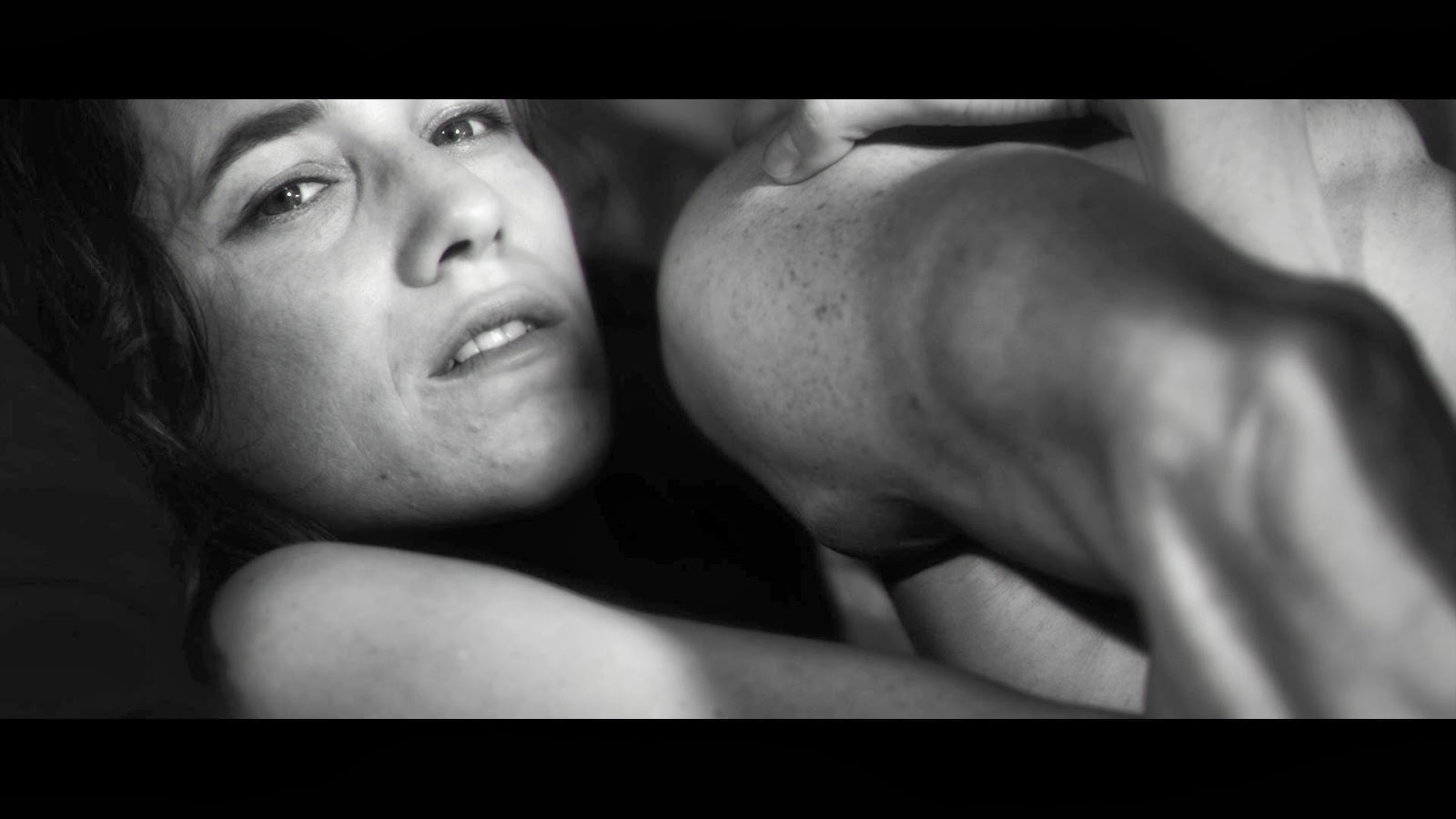
Taken together, the original scene and the flashback are remarkably congruent with the epistemological implications of the Lacanian concept of the gaze as such. We might call the Prologue’s production of anxiety and affective excess the production of an extreme “epistemological wobble” in that it works to constantly undermine any possible subject position that might fantasize itself as immune to the real of the gaze. For Lacan, of course, the human subject is split by its symbolic constitution into the imaginary ego and the subject of the unconscious; and the discourse of the symbolic has the character of a signifying chain, so that the subject in the symbolic is also reduced to the signifier. Consequently, the meaning of the subject of the signifier does not encompass the subject of the unconscious, so the subject is alienated from its (own) subject of the unconscious. The splitting that occurs within the subject by its subjection to the signifying constitution of the Other has consequences for the subject’s perception as well. In the act of perception too the subject is split, since objects are perceived by the ego, the subject of the signifier, and desired by the subject of the unconscious. According to Lacan since the subject is an effect of the signifier, and thus constitutionally split, the subject has to constantly reconstruct and reassure itself through its discourses.
In theory derived from Lacan the term suture is used to describe the process of the construction and incorporation of the subject in discourse, the means by which the subject recognizes the discourse as its own, and attempts to secure a degree of coherence within the discourse. Stephen Heath elaborates it as follows:
“[T]he "I" is a division but joins all the same. The stand-in is the lack in the structure but nevertheless, simultaneously, the possibility of a coherence, of the filling in. At the end of the suturing function is the ego, the "me": "it's me!", the little linguistic scenario of the ego - that I am the only one who can say. Can say insofar as I am one. The ego is not to be confused with the subject: it is the fixed point of imaginary projection and identification, where the subject as such is always on the side of the symbolic, the latter the order of its very constitution: but then, precisely, there is no ego without a subject, terrain of its necessity and its hold: function of the symbolic, suture is towards the imaginary, the moment of junction - standing in, a taking place, a something, a some one there.”[x]
In strict Lacanian terms suture thus refers to the stitching of the imaginary, symbolic and real registers, with the seam separating the real from reality, closing off the unconscious from conscious discourse. Suture thus prevents the subject from losing its status as a subject, prevents it from falling into the void of the real, which would be falling into psychosis. But suture also has a narrower epistemological dimension in that it names a kind of closure, a sewing up of the subject’s fictional place within ideology and providing the subject with a false impression of plenitude and coherence.
In film studies suture has been elaborated in terms of how formal, technical operations in the construction of the film narrative relate to the production of meanings and the creation of subject-positions for the viewer. Kaja Silverman writes that
“... cinematic coherence and plentitude emerge through multiple cuts and negations. Each image is defined through its differences from those that surround it syntagmatically and those it paradigmatically implies ("this but not that"), as well as through its denial of any discourse but its own. Each positive cinematic assertion represents an imaginary conversion of a whole series of negative ones. This castrating coherence, this definition of a discursive position for the viewing subject which necessitates not only its loss of being but the repudiation of alternative discourses, is one of the chief aims of the system of suture...Most classic cinematic texts go to great lengths to cover over these "cuts."” [xi]
In the case of the Prologue to ‘Antichrist’, von Trier goes to great lengths to not cover over these cuts. While the Prologue has coherence at the level of plot, that coherence stands in an ironic relationship to the film’s foregrounding of its own suturing process, its own fictional construction.
In addition to the cuts between images I talked about earlier, the Prologue also emphasizes its manipulation of the viewer’s subject position by a constant shifting of camera angles; remarkably, though, some of these camera angles are also the means by which the viewer is forced to question her own habitual subject position in her own habitual discourse as the subject of ideology. They work to make the gaze of the real inescapable, to unhinge the comforts of the viewer’s own suturing discourse.
These are the camera angles that place the viewer in an “impossible” subject position, and the most disturbing of them occur around the scenes of the child’s fall.
When Nick first steps out onto the window ledge we view him from above, from a position which encompasses his viewpoint but is not identical with it, and is physically impossible within the diegetic reality of the film.
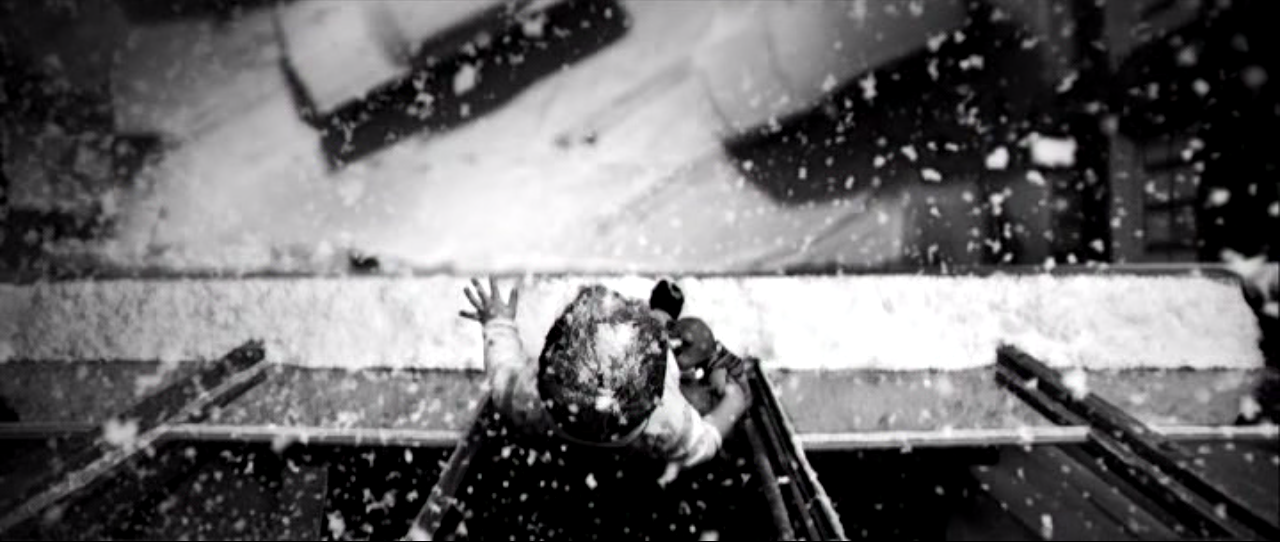
The film then cuts
to a medium close-up of the child just as he loses his balance and begins to
fall; this shot is from an equally impossible angle—eye-level, outside the
window. Very quickly the film cuts to a high-angle close-up of She’s face in
the throes of sexual pleasure before cutting back to the falling child, shot
from the same angle as before. Variations on this outside/inside shot sequence
with similar camera angles occur over the next two minutes, all in all adding
up to thirteen cuts which the slow-motion seems to achingly prolong.
I want to think about this for a moment using one of Žižek’s
formulations of “the elementary logic of suture” as he writes about it in The Fright of Real Tears.[xii]
"Firstly”, he says, “the spectator
is confronted with a shot, finds pleasure in it in an immediate, imaginary way,
and is absorbed by it". Here we can think of some of the shots of She and
He having sex. “Then, this full immersion is undermined by the awareness of the
frame as such: what I see is only a part, and I do not master what I see. I am
in a passive position, the show is run by the Absent One (or, rather, Other)
who manipulates images behind my back”. On one level the many cuts, the
black-and-white, and the soundtrack work this way. “What then follows is a
complementary shot which renders the place from which the Absent One is
looking, allocating this place to its fictional owner, one of the protagonists”.
This, however, is where von Trier adds a significant complication. This “place
from which the Absent One is looking” cannot be the place of one of the
protagonists. It is a profoundly empty place rendered in the impossible camera
angles and positions. It is the God’s-eye view of Nick falling and of his fall.
It is a place the viewer occupies briefly with radical unease, realizing the impossibility of that occupation by any
subject. And then realizing it as the last trick of suture—it is a position
occupied by God. Except that it’s empty. And then we see the gaze of the real:
the amorphous stain of Nick’s physical death in the snow before which we are
helpless.

3.
Two aspects of the
Prologue which I have only mentioned in passing now need some further comment—
its being filmed in black-and-white and slow-motion, and the music which
constitutes the soundtrack.
One one level both the technique and the music foreground the artificiality of the filmic construct, and thus can be seen as part of the process by which the actuality and function of the suture is revealed. Beyond this, however, I think, once again, that these formal decisions have a specific philosophical import, intimating a philosophical anthropology which arguably the rest of the film exemplifies and displays. I will turn once more to Žižek to articulate what’s involved here.
Obviously any black-and-white film with a musical soundtrack but without speakers will reference the early years of cinema and evoke a certain formalistic nostalgia, successfully commodified, for example, in Hazanavicius’s The Artist (2011). However von Trier’s cinematic stance here is far more ironic given the content and the highly sophisticated set of filmic techniques. In Enjoy Your Symptom[xiii], Žižek comments on how historically the introduction of voice into cinema “changes the whole economy of desire, the innocent vulgar vitality of the silent movie is lost, we enter the realm of double sense, hidden meaning, repressed desire—the very presence of the voice changes the visual surface into something delusive, into a lure[.]” And quoting Pascal Bonitzer (“Film was joyous, innocent and dirty. It will become obsessive, fetishistic, and ice-cold”), he concludes that “film was Chaplinesque, it will become Hitchcockian”. I don’t think it’s too much to say that von Trier’s Prologue is a Hitchcockian film in a Chaplinesque mask. Chaplin’s world, to quote Bonitzer again, is a “world of pure gesticularity...the protagonists are generally immortal...violence is universal and without consequences, there is no guilt”. In the Prologue it is as if von Trier negates this statement and tarries with the negation: gesticularity contracts into grimace, violent death is central, and everyone is guilty.
It must be noted too that the absence of voice in the diegesis is only an apparent absence. For the soundtrack’s dominating sonic presence is not simply music but song which synchronizes with the narrative and declares in full Baroque gorgeousness:
One one level both the technique and the music foreground the artificiality of the filmic construct, and thus can be seen as part of the process by which the actuality and function of the suture is revealed. Beyond this, however, I think, once again, that these formal decisions have a specific philosophical import, intimating a philosophical anthropology which arguably the rest of the film exemplifies and displays. I will turn once more to Žižek to articulate what’s involved here.
Obviously any black-and-white film with a musical soundtrack but without speakers will reference the early years of cinema and evoke a certain formalistic nostalgia, successfully commodified, for example, in Hazanavicius’s The Artist (2011). However von Trier’s cinematic stance here is far more ironic given the content and the highly sophisticated set of filmic techniques. In Enjoy Your Symptom[xiii], Žižek comments on how historically the introduction of voice into cinema “changes the whole economy of desire, the innocent vulgar vitality of the silent movie is lost, we enter the realm of double sense, hidden meaning, repressed desire—the very presence of the voice changes the visual surface into something delusive, into a lure[.]” And quoting Pascal Bonitzer (“Film was joyous, innocent and dirty. It will become obsessive, fetishistic, and ice-cold”), he concludes that “film was Chaplinesque, it will become Hitchcockian”. I don’t think it’s too much to say that von Trier’s Prologue is a Hitchcockian film in a Chaplinesque mask. Chaplin’s world, to quote Bonitzer again, is a “world of pure gesticularity...the protagonists are generally immortal...violence is universal and without consequences, there is no guilt”. In the Prologue it is as if von Trier negates this statement and tarries with the negation: gesticularity contracts into grimace, violent death is central, and everyone is guilty.
It must be noted too that the absence of voice in the diegesis is only an apparent absence. For the soundtrack’s dominating sonic presence is not simply music but song which synchronizes with the narrative and declares in full Baroque gorgeousness:
Lascia ch'io pianga
Let me weep
Mia cruda sorte,
for my cruel fate
E che sospiri
And sigh
La libertà.
after freedom
Let me weep
Mia cruda sorte,
for my cruel fate
E che sospiri
And sigh
La libertà.
after freedom
Il duolo infranga
May sorrow break
Queste ritorte,
these ropes
De' miei martiri
of my sufferings
Sol per pietà.
out of pity
May sorrow break
Queste ritorte,
these ropes
De' miei martiri
of my sufferings
Sol per pietà.
out of pity
It is easy to see
how the words of this aria from Act II, Scene 2 of Handel’s Rinaldo serve as a lament by the parents
for tragic death of their son, perhaps especially on the part of She. Better,
perhaps, is to see them as a lament for the human condition in general, the
inevitable traumatic encounter with the real which is the fate and lot of
everyone.
There is also, however, the specific context of the opera from which it’s taken: set during the First Crusade, and based on Tasso’s Gerusalemme Liberata, it narrates the tale of Christian forces led by their general, Goffredo, and the heroic knight Rinaldo, as they lay siege to Jerusalem to conquer its Muslim king, Argante. King Argante is allied with and enamored of Armida, the queen of Damascus, who is a sorceress. Goffredo has promised Rinaldo the hand of his daughter Almirena once Jerusalem falls. Through her magical powers Armida knows that the Christian armies will be defeated if they are without Rinaldo, and so while Rinaldo and Almirena are rejoicing in their love in a beautiful garden, Armida magically appears and takes Almirena from Rinaldo's arms, summoning up monsters to subdue him when he tries to resist. In Rinaldo’s search for Almirena he is brought by a mermaid to Armida’s enchanted castle. There King Argante, having seen Almirena, falls madly in love with her, and, as she sings the above aria lamenting her fate, he promises to free her. Meanwhile, Rinaldo confronts Armida and demands the return of Almirena, but the sorceress is struck with love for him and offers herself to him. When he rejects her, she transforms herself into the likeness of Almirena. He is temporarily bewitched, but comes to his senses and spurns her. He escapes and she is torn between love for him and the desire for revenge. Argante happens upon her while she is disguised as Almirena and promises again to liberate her. She reproaches him for his faithlessness and he defies her, only to be overcome by her superior magical powers.
It is remarkable how this part of the tortuous opera plot (there is much more, including the eventual conversion of Armida to Christianity after her defeat through “good” magic) will eventually map onto the main narrative of the film in a darkly parodistic way—like Rinaldo, the main plot of Antichrist will employ elements of love, desire, revenge, the monstrous, the supernatural, a quasi-magical place set apart, and the figure of the sorceress. But the melodrama of Rinaldo’s plot and the sumptuosness of its music are twisted into affective excess, graphic violence, and the unmusic of Nature, the cries of animals and acorns clattering on a roof.
I am arguing that the clash of the two narratives, prepared for here in the Prologue, exposes the universalizing thrust of western Christian culture as endless grandiose suturing, a melodramatic metanarrative of redemption through sanctioned violence against any Other. And yet it is always and forever accompanied by its obscene opposite and complement. There is Christ and there is Antichrist, the one encompassing the Logos, the masculine, the Lacanian “subject supposed to know”, scientific rationality, consciousness, Culture; the other encompassing the female, unreason, the unconscious, prejudice, emotion, Nature. But furthermore, I want to suggest that the entire constitution of the Prologue will not allow a simple and simplistic overturning of this set of binaries, privileging one over the other; rather, by allowing the appearance of the gaze of the real, by exposing sutural strategies, and undoing our pleasure in a product of high culture, the Prologue espouses a deep skepticism towards any fundamental coherence, closure or plenitude. At best, it is an “adoration of the question”[xiv]; at worst “None of it is any use”, and “Chaos reigns”[xv]. There is gravity, but there is no grace to redeem it.
There is also, however, the specific context of the opera from which it’s taken: set during the First Crusade, and based on Tasso’s Gerusalemme Liberata, it narrates the tale of Christian forces led by their general, Goffredo, and the heroic knight Rinaldo, as they lay siege to Jerusalem to conquer its Muslim king, Argante. King Argante is allied with and enamored of Armida, the queen of Damascus, who is a sorceress. Goffredo has promised Rinaldo the hand of his daughter Almirena once Jerusalem falls. Through her magical powers Armida knows that the Christian armies will be defeated if they are without Rinaldo, and so while Rinaldo and Almirena are rejoicing in their love in a beautiful garden, Armida magically appears and takes Almirena from Rinaldo's arms, summoning up monsters to subdue him when he tries to resist. In Rinaldo’s search for Almirena he is brought by a mermaid to Armida’s enchanted castle. There King Argante, having seen Almirena, falls madly in love with her, and, as she sings the above aria lamenting her fate, he promises to free her. Meanwhile, Rinaldo confronts Armida and demands the return of Almirena, but the sorceress is struck with love for him and offers herself to him. When he rejects her, she transforms herself into the likeness of Almirena. He is temporarily bewitched, but comes to his senses and spurns her. He escapes and she is torn between love for him and the desire for revenge. Argante happens upon her while she is disguised as Almirena and promises again to liberate her. She reproaches him for his faithlessness and he defies her, only to be overcome by her superior magical powers.
It is remarkable how this part of the tortuous opera plot (there is much more, including the eventual conversion of Armida to Christianity after her defeat through “good” magic) will eventually map onto the main narrative of the film in a darkly parodistic way—like Rinaldo, the main plot of Antichrist will employ elements of love, desire, revenge, the monstrous, the supernatural, a quasi-magical place set apart, and the figure of the sorceress. But the melodrama of Rinaldo’s plot and the sumptuosness of its music are twisted into affective excess, graphic violence, and the unmusic of Nature, the cries of animals and acorns clattering on a roof.
I am arguing that the clash of the two narratives, prepared for here in the Prologue, exposes the universalizing thrust of western Christian culture as endless grandiose suturing, a melodramatic metanarrative of redemption through sanctioned violence against any Other. And yet it is always and forever accompanied by its obscene opposite and complement. There is Christ and there is Antichrist, the one encompassing the Logos, the masculine, the Lacanian “subject supposed to know”, scientific rationality, consciousness, Culture; the other encompassing the female, unreason, the unconscious, prejudice, emotion, Nature. But furthermore, I want to suggest that the entire constitution of the Prologue will not allow a simple and simplistic overturning of this set of binaries, privileging one over the other; rather, by allowing the appearance of the gaze of the real, by exposing sutural strategies, and undoing our pleasure in a product of high culture, the Prologue espouses a deep skepticism towards any fundamental coherence, closure or plenitude. At best, it is an “adoration of the question”[xiv]; at worst “None of it is any use”, and “Chaos reigns”[xv]. There is gravity, but there is no grace to redeem it.
4.
All whom the flood did, and fire shall o'erthrow,
All whom war, dearth, age, agues, tyrannies,
Despair, law, chance hath slain...(John Donne)
All whom the flood did, and fire shall o'erthrow,
All whom war, dearth, age, agues, tyrannies,
Despair, law, chance hath slain...(John Donne)
All the foregoing is
really but a prolegomena to engaging with the rest of Antichrist. And if anything, this reading of the Prologue should
head off any sense that this is a misogynistic film: the binaries mentioned
above and which thread throughout the film’s narrative are highlighted as gendered, not because one element or the
other is in-itself gendered but because in the discourses of western Culture, in
the Christian “answer” (and its Platonic precursor) they are structured that
way. Luce Irigaray has argued that the Western philosophical tradition has
privileged the concept of “presence” which then underwrites the concepts of
Being, Truth, and God, among others, which are then themselves privileged over
other elements of the metaphysical system.[xvi]
These become the positive terms in a set of binaries where the second term is
negative, such as Presence/Absence, Being/Nothing, Truth/Error,
Identity/Difference, and Masculine/Feminine. If Antichrist presents, for example, madness as feminine, it is only
because it is acknowledging that the world has still not managed to integrate
the deconstruction of such a binary into its notions of either madness or the
feminine. The old hierarchy reigns and enforces its structural valorization of
the masculine and rationality as it represses its anxiety at female jouissance. In Antichrist He, the therapist, enlightened “subject supposed to
know”, can’t even hear She’s effort to undo such a binary and its valorization
(no matter which term is the positive); their dialogue proceeds as follows:
She: I discovered something else in my material than I expected. If human nature is evil, then that goes as well...for the nature of...
He: Of the women? Female nature?
She: The nature of all the sisters. Women do not control their own bodies -Nature does. I have it in writing in my books.
He: The literature that you used in your research was about evil things committed against women. But you read it as proof of the evil of women? You were supposed to be critical of those texts, that was your thesis. Instead you're embracing it. Do you know what you're saying
She: Forget it.
She: I discovered something else in my material than I expected. If human nature is evil, then that goes as well...for the nature of...
He: Of the women? Female nature?
She: The nature of all the sisters. Women do not control their own bodies -Nature does. I have it in writing in my books.
He: The literature that you used in your research was about evil things committed against women. But you read it as proof of the evil of women? You were supposed to be critical of those texts, that was your thesis. Instead you're embracing it. Do you know what you're saying
She: Forget it.
“Women do not control
their own bodies—Nature does”: the corollary to that, of course, is that
neither do men control their own bodies; Nature, neither masculine nor
feminine, does. But that is unhearable by He.
Žižek
once wrote that
All ‘culture’ is in a way a reaction-formation, an attempt to limit, canalize--
All ‘culture’ is in a way a reaction-formation, an attempt to limit, canalize--
to cultivate th[e] imbalance, th[e] traumatic kernel, th[e]
radical antagonism
through which man cuts his umbilical cord with
nature, with animal
homeostasis. It is not only that the aim is no
longer to abolish this drive
antagonism, but the aspiration to abolish it
is precisely the source of
totalitarian temptation: the greatest mass
murders and holocausts have
always been perpetrated in the name of man as
harmonious being, of a
New Man without antagonistic tension.[xvii]
In Antichrist,
in the last scene, He, having killed and burned She, walks away from Eden and
meets, coming up the hill towards him crowds of women, and because their faces
are blurred, he is no longer the object of the female gaze; they pass him by
and he passes among them unconcerned, eating berries in a Nature open for his
needs, bright, and unthreatening. This New Man is still the Old, the one who
burned witches, the one who sacrifices “Truth for the sake of knowledge.”[xviii]

[i]
Last words of Antichrist
[ii] Žižek,
Slavoj. “Looking Awry” In Stam and Miller (eds) Film and Theory an Anthology. Oxford:
Blackwell, 2000. 524-538
[iii]
McGowan, Todd, The Real Gaze: Film Theory After Lacan. SUNY Press, 2008, p.28
[iv]
McGowan, ibid.
[v]
Žižek, ibid.
[vi]Lacan,
Jacques, Seminar XI, W.W. Norton, 1998, p. 21
[vii]
Fink, Bruce, ‘The Real Cause of Repetition’ in Reading Seminar XI, ed. Feldstein, Fink, Jaanus, SUNY
Press, 1995, p.225
[viii]
Bowie, Malcolm, Lacan, Harvard Univ. Press, 1993, p.103
[ix]
Ross, Stephen, ‘AVery Brief Introduction to Lacan’, online article, http://web.uvic.ca/~saross/lacan.html
[x] http://www.lacan.com/symptom8_articles/heath8.html
[xi]
Silverman, Kaja, The Subject of Semiotics , New York: Oxford University Press,
I983, p. 204
[xii]
Žižek, Slavoj, The Fright of
Real Tears: Krzysztof Kieślowski Between Theory and Post-Theory, London:
BFI Publishing, 2001, p.32
[xiii]
Žižek, Slavoj, Enjoy Your Symptom, Routledge, 2008, p. 2
[xiv] Hegel
[xv]Dialogue
from Antichrist available at http://www.script-o-rama.com/movie_scripts/a/antichrist-script-transcript-chaos-reigns.html
[xvi]
Irigiray, Luce, Speculum of the Other Woman, Cornell University Press, 1995.
[xvii]
Žižek, Slavoj, The Sublime Object of Ideology, Verso, 2008, p. xxviii
[xviii]
This meditation originates in various conversations I had with my friend and
colleague David Denny whose own paper ‘A Postmodern Family Romance: Lars von
Trier’s Antichrist’ is a brilliant reading
of the film as a whole.
All film stills are ©IFC Films and are used for
scholarly illustrative purposes only.
©Ger Killeen 2014

